
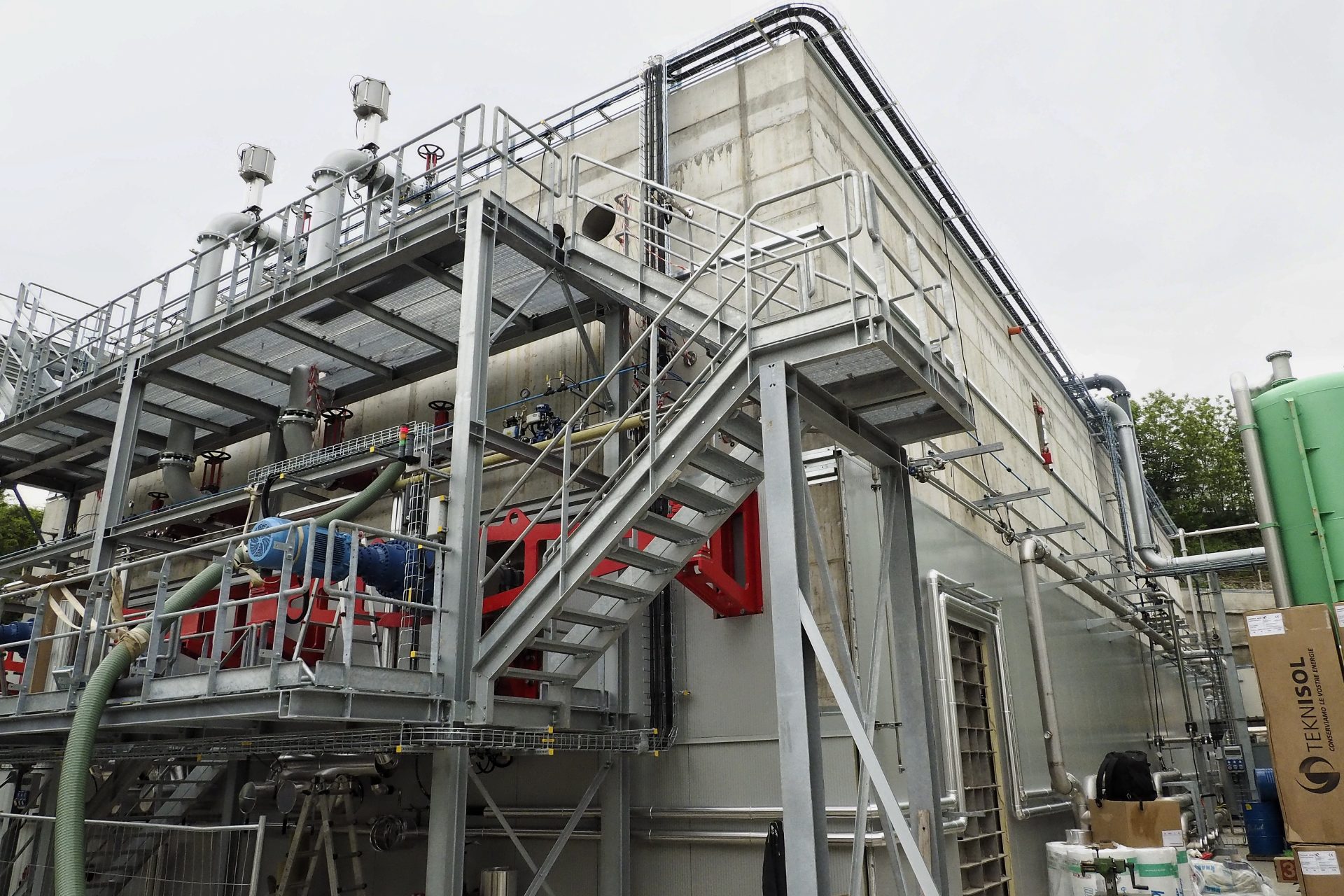
ACSR S.p.A.’s new biogas plant in Borgo San Dalmazzo, built with funding from the PNRR, has entered the start-up phase. The facility will convert the organic fraction of municipal solid waste—the food waste we separate at home every day—into biomethane and high-quality compost.
The project was completed within the timeframe set by the PNRR, an achievement that was by no means a given during a period marked by rising material costs and supply chain disruptions.
The Consorzio Ecologico Cuneese, a public entity and beneficiary of PNRR funding, comprised of the same 54 member municipalities of ACSR S.p.A., manages the collection and transport of municipal waste using solutions geared toward the circular economy.
According to CEC Consortium President Pier Giacomo Quiriti, “this biogas digester is an important investment for the region. As a Consortium, we have supported this project since the application phase; it strengthens the local public system and guarantees environmental and economic benefits in the medium to long term.”
The plant, which complements the existing aerobic composting section, uses a closed, vacuum-operated “semi-dry” anaerobic digestion technology capable of processing 35,000 tons of food waste and 10,000 tons of wood and green waste annually. The biomethane produced—over 3.4 million cubic meters per year—will be fed into the national gas grid, generating over 35,000 MWh of renewable energy, equivalent to the energy needs of approximately
Giancarlo Isaia, President of ACSR S.p.A., highlights the strategic value of the project: “For our 54 member municipalities, representing over 160,000 residents, this biogas plant is not just a state-of-the-art facility. It demonstrates that the public sector can work together, secure European funding, and carry out projects that provide tangible benefits to citizens. We have closed the loop of the circular economy: organic waste is a resource that produces clean energy as well as fertilizer for our agriculture.”
Cristiana Giraudo, General Manager of ACSR S.p.A., reports: “A central aspect of the project was strict adherence to the deadlines set by the PNRR. The non-repayable grant of 12.9 million euros—out of a total investment of approximately 16 million—was in fact tied to a particularly tight schedule. The work, awarded through a European tender to ENTSORGA Italia S.p.A., began with civil works on December 13, 2024, and was completed on March 31, 2026, with the installation of all technological equipment. The commissioning and start-up phase began in April and is still ongoing, with the goal of reaching full operational capacity by summer. During this phase, all existing plant lines remained active, preventing the waste produced in our municipalities from being sent to other facilities.”
The chosen technology does not require any water input and reduces leachate production by 90% compared to traditional facilities. The digestion tanks are sealed, and the plant operates under negative pressure with biofilter systems that significantly reduce odorous emissions—a major concern for communities living near such facilities. Furthermore, the increase in heavy traffic will be extremely limited: only four additional vehicles per day, including both incoming and outgoing traffic.
From an energy perspective, the balance is largely positive. With the plant’s total annual energy consumption at 5,000 MWh, biomethane production alone exceeds 35,000 net MWh per year. This means that each year, the biogas plant will return to the region six times the energy that ACSR consumes, contributing substantially to the ecological transition of the Cuneo area.
Francesco Galanzino, CEO of ENTSORGA Italia S.p.A., highlights the technical and organizational achievement: “Building a biogas plant of this complexity in just over fifteen months, while adhering to the PNRR requirements, was an exciting challenge. We installed cutting-edge technologies such as the Spider® automatic overhead crane, the Cow® plug-flow digester, the Butterfly System® membrane upgrading system, and the Eagle Cloud® control platform. But the real success was the teamwork with ACSR: a competent and determined public client that was able to tackle unforeseen challenges alongside us without ever losing sight of the ultimate goal.”
Currently, the 54 member municipalities produce approximately 10,000 tons of organic waste annually. To reach full capacity of 35,000 tons, ACSR S.p.A. is working in synergy with other municipalities in the Province of Cuneo to make the Borgo San Dalmazzo biogas plant the go-to facility for all organic waste at the provincial level. A goal that will eliminate most out-of-province transport, with clear benefits in terms of lower emissions and reduced treatment costs.
A strategic facility, a further step on the path toward European energy autonomy.
The opening of the new Borgo San Dalmazzo facility is part of the broader initiative undertaken by the European Union to strengthen its energy security and accelerate the transition to a low-carbon system. In recent years, in fact, Europe has launched a strategy aimed at significantly reducing its dependence on imported natural gas, focusing on increased domestic energy production from renewable sources.
In this context, the REPowerEU plan has set ambitious targets to increase biomethane production, which is no longer viewed as a niche solution but as an immediately available source that can be integrated into existing infrastructure to replace part of the fossil gas supply and improve the continent’s energy self-sufficiency. At the same time, initiatives such as NextGenerationEU are mobilizing unprecedented resources to accelerate investments in clean and innovative infrastructure and technologies, fostering the development of projects that combine economic growth with sustainability. On the regulatory front, the Renewable Energy Directive (RED) III raises the bar even higher, setting binding targets to produce at least 42.5% of energy from renewable sources by 2030 (with a goal of reaching 45%) and strengthening targets for reducing climate-changing emissions in the energy and industrial sectors.
Anaerobic digestion and biomethane production facilities, such as the new ACSR S.p.A. biogas plant, therefore play a key role, contributing to the recovery of organic waste and, at the same time, to decarbonization. These strategic projects represent a concrete step toward an increasingly independent, sustainable, and resilient energy system.
Mark your calendars for May 15 for the official inauguration.
The official opening is scheduled for May 15, 2026, at 3:00 p.m. at the ACSR S.p.A. headquarters in Borgo San Dalmazzo. This event is made possible thanks to the support and collaboration of the following partners: LegaAmbiente Cuneo, Bra Servizi Srl, Banca CRS, Entsorga Italia S.p.A., Buzzi Unicem S.p.A., Co.fi.r. Srl, Autotrasporti Mairone Srl, Escavazioni 3M Srl, Costruzioni Edili Comino, and M.A.E.F. Srl. An event to present to the community an infrastructure designed not only to manage waste but also to generate environmental, economic, and social value for the entire Cuneo region.
On Saturday, May 16, from 9:00 a.m. to 12:00 p.m., the facility will be open to the public with guided group tours every 30 minutes, allowing everyone to see up close how organic waste is transformed into energy and fertilizer.
